AI visibility tools track how often an assistant mentions, recommends or cites your brand, and published prices in July 2026 run from $29 a month to $489 a month before you reach enterprise quotes. What you are buying is prompts multiplied by engines, not features, and once you normalise for that the spread between vendors is roughly six to one. Whether you should buy anything at all comes down to how many brands you report on.
Before any of that, something about the pages you have been reading, including the ones ranking above this one.
Why does every "best AI visibility tools" list rank its own author first?
Because the format rewards it, and nobody has been punished for it yet.
We pulled the live top ten for "ai visibility tools" while researching this, and the pattern held on nearly every result. One vendor's list puts its own product at number one. A second vendor's list, ranking third, puts its product at number one. A well-known consultant leads with the tool he sells. And a content-optimisation platform's roundup of the nine best options features, with a certain inevitability, that same content-optimisation platform.
None of this is fraud. Ranking yourself in your own listicle is a normal, widely used tactic, and it works well enough that it has become the default. It just means the eight pages you consulted before landing here were written by people with a direct financial stake in the answer.
Two things follow, one of which is uncomfortable for us.
The tactic now carries SEO risk. Lily Ray published an analysis in February 2026 asking whether Google is cracking down on self-promotional listicles, and classified them as "gray area" SEO. Her strongest point is about evidence: Google has long asked review content to demonstrate real testing of what it reviews, and these pages, in her words, "almost always lack this evidence." She also documented the reciprocal variant, where competitors agree to feature each other, which she describes as a modern twist on reciprocal linking.
This article is that format. So here is our disclosure, in full. Aiter does not sell an AI visibility tracker, so we have nothing to win in this race. We have not run controlled side-by-side tests of every product on the market, so you will not find us declaring a winner. Every price below was read off the vendor's own pricing page in July 2026 rather than copied from another listicle, and where a vendor does not publish a price, we say so instead of guessing.
And one more rule we have set for this page: we name tools, but we do not link to any of them. You can type a name into a search box. What we are not going to do is hand link equity to nine companies while telling you to be sceptical of pages that do exactly that.
What do AI visibility tools actually cost?
More than the listicles imply, and the headline number is close to meaningless until you divide it by what you get.
Here is what the vendors themselves publish, read in July 2026. Prices move fast in this category, so treat these as a snapshot with a short shelf life and check before you buy.
| Tool | Plan | Price per month | Prompts | Engines |
|---|---|---|---|---|
| Otterly | Lite | $29 | 15 | 4 |
| Profound | Starter | $99 | 50 | 1 (ChatGPT) |
| Otterly | Standard | $189 | 100 | 4 |
| Profound | Growth | $399 | 100 | 3 |
| Otterly | Premium | $489 | 400 | 4 |
| Peec AI | Starter to Enterprise | Not published | Not published | Not published |
Profound's plans are billed yearly. Otterly's monthly rates drop about 15% if you pay annually. Peec AI lists four tiers and no prices at all, which is its own kind of answer.
Now the part nobody publishes. Divide the price by the number of checks each plan actually performs, where one check is one prompt on one engine.
| Plan | Prompt-engine checks | Cost per check |
|---|---|---|
| Otterly Premium | 1,600 | $0.31 |
| Otterly Standard | 400 | $0.47 |
| Otterly Lite | 60 | $0.48 |
| Profound Growth | 300 | $1.33 |
| Profound Starter | 50 | $1.98 |
That is a spread of roughly six to one on published prices.
A caveat is needed here, because a single ratio is exactly the kind of reductive score this article has spent 400 words complaining about. Cost per check says nothing about how good the data is, how often it runs, whether you get citation-level detail, whether you can white-label a report, or whether the interface is bearable at nine in the morning. Profound is aimed at a different buyer than Otterly is, and the $99 plan covering only ChatGPT is a positioning decision rather than an oversight.
But it does tell you one true thing. If two vendors are within a rounding error on features, and one costs four times more per check, you should at least make them explain why.
Takeaway: before any demo, work out your own cost per check for each shortlisted plan. It takes two minutes and it reframes the entire conversation, because the sales deck is built around features and the invoice is built around volume.
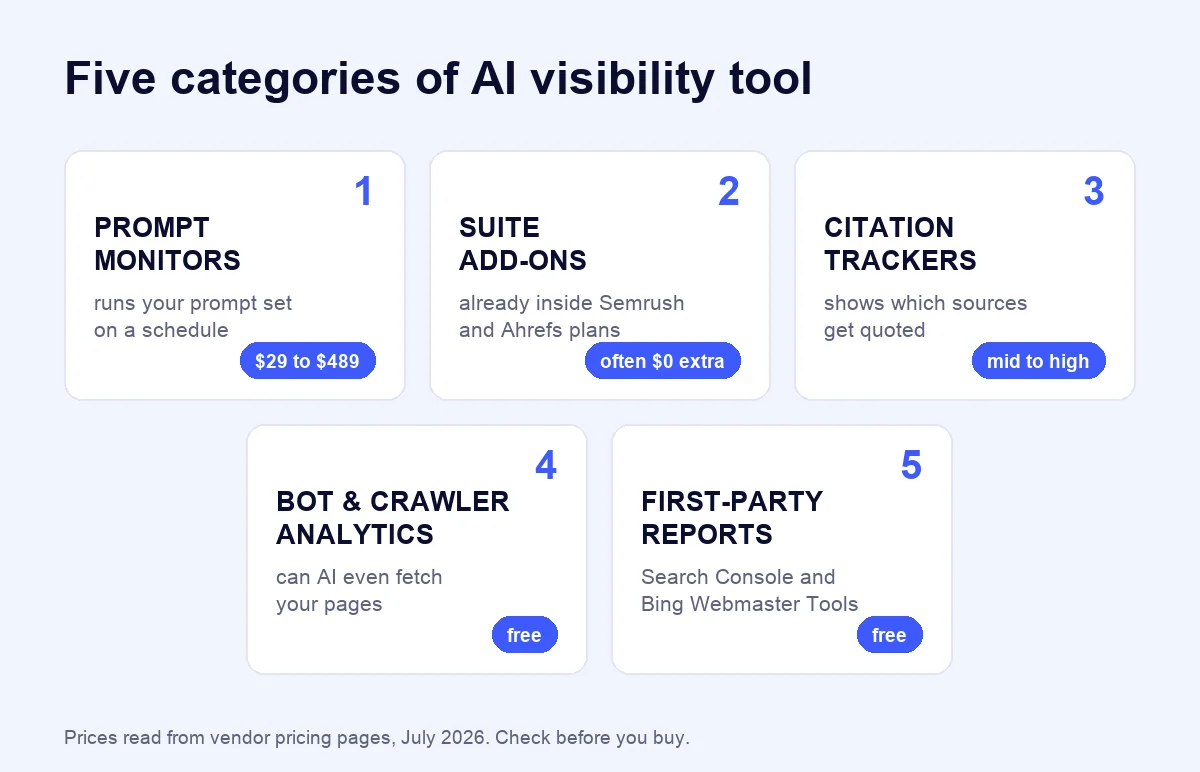
The five categories of AI visibility tool
Products here cluster into five jobs. Most vendors do two of them well and market all five.
1. Prompt monitors
Run a fixed prompt set across engines on a schedule and log whether you were mentioned. This is the core of the category and where Profound, Otterly and Peec AI all live. Expect $29 to $489 a month depending on volume.
Buy one if somebody other than you reads a monthly trend.
2. Suite add-ons
If you already pay for a big SEO platform, you may own this already and not know it.
Semrush has no separate AI product. AI prompt tracking is built into the plans: 50 prompts a day on Starter at $165.17 a month billed annually, 100 on Pro+ at $248.17, 200 on Advanced at $455.67. Ahrefs bundles Brand Radar into Lite at £99 a month, Standard at £199 and Advanced at £359, and also sells it standalone from £159 with smaller custom-prompt packs at £40, £80 and £200.
So a team already on Semrush Pro+ is tracking 100 prompts a day at a marginal cost of nothing. Cancel your separate tracker and find out whether anybody notices. Genuinely, this is the single most common piece of money left on the table in this category.
3. Citation and source trackers
These answer a different question: not "was I mentioned" but "which URLs and third-party pages did the model quote." That matters because in most categories the pages getting cited are comparison articles, directories and forum threads rather than any vendor's own website.
You can approximate this for free by logging a fourth column in a manual audit, which is covered in the step-by-step AI visibility audit. Pay for it when you have more brands than patience.
4. Technical auditors and bot analytics
The unglamorous category, and the one that quietly matters when your score is zero.
This covers crawler access, entity consistency, structure, and which AI bots are actually fetching your pages. Cloudflare and your own server logs will tell you most of it at no cost. An r/SEO thread this month made the distinction cleanly: bot analytics tells you whether you can be cited, visibility tracking tells you whether you are.
One caveat, from an SEO in that same thread who has audited roughly 17,000 small business sites this year: access is almost never the bottleneck. Robots.txt is usually fine and GPTBot is usually not blocked. What kills those sites is that nothing on the page can be lifted out as a standalone answer. That is a writing problem in a technical costume, and it gets fixed by mapping content to the questions people actually search rather than by another crawl. So check this category once, fix anything broken, and then stop staring at it.
5. The free first-party reports
The category everybody forgets, because nobody sells it.
Google's generative AI performance report in Search Console gives you impressions from AI Overviews and AI Mode. Bing Webmaster Tools gives you citations from Copilot, plus grounding queries, the phrases the assistant writes for itself when it goes hunting for sources, mapped to the pages they cited. Neither gives you clicks. Both are free and both come from the platform rather than from a script pretending to be a browser.
We would set both up before spending a penny anywhere else. The Google half is covered in what Search Console's AI report shows and hides.
Which category fits your situation?
Five questions. Recommends a category, never a brand.
How many brands do you report on?
Who reads the report?
How many prompts genuinely matter?
Do you already pay for an SEO platform?
Any suspicion that AI crawlers cannot read your site?
Answer all five and you will get a category, plus the reason. 5 to go.
Who should skip AI visibility tools entirely?
Four situations, and we would put most single-product companies in the first one.
- You report on one brand and nobody demands a monthly chart. Run the manual audit quarterly. It costs an afternoon and produces the same trend line.
- You already pay for Semrush or Ahrefs. You are very possibly buying the same data twice. Check your existing plan before you renew anything.
- You have fewer than 20 prompts worth tracking. Below that, sampling noise is larger than any change a tool will show you, and you will spend the year reacting to randomness with a straight face.
- You bought one already and have not opened it since March. Say the number out loud, cancel it, and revisit in six months when the category has settled down.
There is a fifth, and it is the one people find hardest to hear. If you are not on page one of Google yet, an AI visibility subscription is measuring a symptom of a problem you already know you have. Google's own position is that its generative features run on core Search ranking systems. You do not need a dashboard to tell you that a page nobody ranks is a page nobody quotes.
What Google says before you spend anything
Check this first, because it may save you the subscription entirely.
Google published a guide to optimizing for generative AI features that answers the question most of these tools exist to complicate. Asked whether normal SEO still applies, Google says: "In short, yes! The best practices for SEO continue to be relevant because our generative AI features on Google Search are rooted in our core Search ranking and quality systems." More bluntly, on the same page: "optimizing for generative AI search is optimizing for the search experience, and thus still SEO."
That guide also names four tactics as unnecessary: llms.txt files, content chunking, AI-specific rewrites, and pursuing inauthentic mentions. If a vendor's pitch leans on any of those four, Google has now contradicted it in writing. We had an llms.txt on this site before that guidance landed, and we could never attribute a single thing to it.
There is academic support for the same caution. A critical survey of generative engine optimization posted to arXiv in July 2026 reviewed 45 studies and found that no evaluated technique consistently improves discoverability, traffic or business outcomes across platforms. The field's one controlled experiment, the Princeton GEO study from KDD 2024, reported that optimisation could "boost visibility by up to 40% in generative engine responses", while noting efficacy varies by domain.
So the honest framing for any purchase: you are buying a thermometer, not a treatment. The treatment is the ordinary work of knowing which rivals keep getting named instead of you, then writing the page that answers the question better than theirs does.
Does ranking on Google mean I am already being cited?
Much less than you would hope, and this is the number that should decide whether you buy anything.
Ahrefs analysed 15,000 prompts and found that only about 12% of URLs cited by ChatGPT, Gemini and Copilot rank in Google's top 10 for the same prompt. ChatGPT's in-text citations overlapped just 8.0% of the time. Perplexity was the outlier at 28.6%.
Ahrefs sells an AI visibility product, so they are not neutral, and we cite them anyway because the sample is large and the methodology is published. Weigh it accordingly.
Put that next to Google's position and both turn out to be true. Ranking makes you eligible. It does not make you quotable. If your audit says you rank well and never get cited, no tool will fix that, because the problem is on your pages rather than in your measurement.
The one feature almost nobody ships
Prompt-level trends.
Ivan Palii, who builds SEO software and has no reason to flatter the category, tested seven leading AI visibility tools in July 2026 and reported that not one of them showed a visibility trend by individual prompt in the table.
That gap matters more than any feature comparison in this article. A tool that tells you overall visibility fell 6% has told you almost nothing you can act on, because you cannot tell whether one high-value prompt collapsed or twelve irrelevant ones drifted. When you demo a tool, ask to see the trend for a single prompt over three months. If the answer is a slide rather than a screen, you have your answer.
Three more questions worth asking any vendor, in the order they will squirm:
- Do you run prompts logged out, and from which country? Personalised results inflate everybody's score.
- How many times do you run each prompt per check? Once is a coin flip. Three times and averaged is a measurement.
- What is my cost per prompt-engine check on this plan? Watch what happens when the number comes out of the sales deck and onto a calculator.
Do AI visibility tools work?
They work as instruments and not as treatments, which is the distinction the marketing tends to blur.
A monitor will tell you accurately that you appeared in 7 of 20 prompts this month against 5 last month. What no tool on the market can currently do is tell you reliably which change caused it, because, per that arXiv survey, the field has not established which techniques consistently move the outcome. Anyone selling causation here is ahead of the evidence and probably knows it.
Which is a good argument for spending your first month measuring rather than optimising. Set up the two free reports, run one manual audit, work out your cost per check, and only then decide whether a subscription buys you anything a spreadsheet does not. If you want the research and drafting side handled while you do that, Aiter generates content from your own site's context, and the audit stays yours.
Right, your turn. Go and look at what you already pay Semrush or Ahrefs for, before you add another line item. We would put decent money on some of you finding prompt tracking sitting there unused.
Frequently asked questions
What is the best AI visibility tool?
There is no single best one, and naming a winner we had not tested against the field under controlled conditions would make this page exactly the thing it spent 400 words criticising. Pick your category from the framework above, shortlist two vendors, and demo both using your own prompt set.
How much do AI visibility tools cost?
Published monthly prices in July 2026 ran from $29 for Otterly's smallest plan to $489 for its largest, with Profound at $99 and $399, and enterprise tiers quoted privately. Normalised to cost per prompt-engine check, the same plans span roughly $0.31 to $1.98.
Is there a free AI visibility tool?
Two, and they come from the platforms themselves. Search Console's generative AI report covers AI Overviews and AI Mode. Bing Webmaster Tools covers Copilot and adds grounding queries. For every other assistant, the free option is a spreadsheet and your own afternoon.
Do I already get this with Semrush or Ahrefs?
Very possibly. Semrush builds prompt tracking into its plans from Starter upward, and Ahrefs bundles Brand Radar into Lite and above. Check what you are paying for before adding a separate subscription.
Do these tools track ChatGPT accurately?
They approximate it. Most query the API or a scripted session, and neither reproduces exactly what a logged-in person sees in the app, because the consumer interfaces layer retrieval and system prompts on top of the model. Directionally useful, precisely wrong.
Can I just use ChatGPT to check my own visibility?
For a spot check, yes. For a trend, no, because your chat history biases the answer and you will not reproduce the conditions next month. Log out and use a fixed prompt set if you want numbers you can compare.
Do I need a tool for every AI engine?
No. Pick the engines your buyers actually use. For most B2B teams that means ChatGPT and Google AI Mode, and adding four more mostly adds noise to the average while multiplying your bill.
Will an AI visibility tool improve my rankings?
Not by itself. It measures. Google's own guidance says the work that moves generative AI visibility is standard SEO and genuinely useful content, so the tool only tells you whether that work landed.