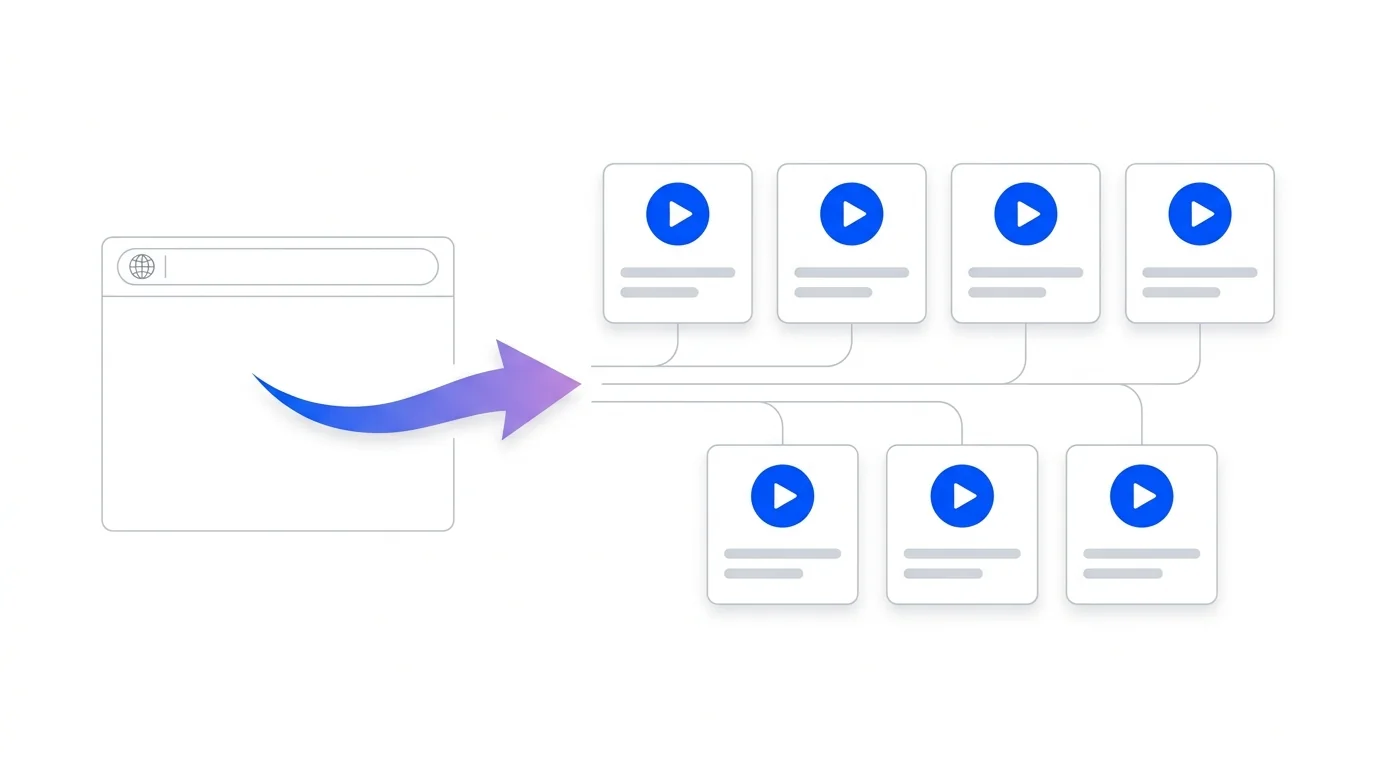
Aiter turns one URL into a working marketing campaign: research, a brief, ad copy for four networks, social posts, blog drafts, emails, keywords, meta tags, PR targets and ad videos. Seven walkthroughs below cover the whole thing, about 51 minutes if you watch them back to back. Most people do not. Start with the overview, then jump to whichever section matches what is blocking you today.
One caveat first, because it changes how you should read them. These were filmed in February and March 2025. The workflow is still the workflow. The interface has since had a full visual refresh, and several of the largest parts of Aiter did not exist yet when the camera was rolling. Where that gap matters we flag it, and there is a table near the end mapping every video to what is different now.
Start with the overview
This is the long one, and the only one that shows the full arc in a single sitting: paste a URL, get a brief, generate ads built around a specific customer need or objection, then work outward into personas and positioning. If you watch one video, watch this.
It predates the research suite, Video Studio, the structured brief, TikTok ads, SEO metadata generation and PDF export. So treat it as the map, not the inventory.
Stage 1: research runs before anything gets written
This is the biggest addition since the videos, and the one that most changes what comes out the other end.
Aiter now runs four separate research passes, each a multi-step investigation rather than one prompt:
- Competitor Analysis verifies 8 to 12 real direct competitors per report, drawn from a much wider candidate pool.
- Market Trends targets 3 to 5 verified trends per category, 15 to 25 in total, each with a named source, a time frame and a concrete implication for your product.
- Target Audience clusters 4 to 6 segments from actual posts on LinkedIn, Reddit, the App Store and Play Store, X, YouTube, TikTok and niche communities, with verbatim quotes you can trace back to a platform.
- Reviews Research mines G2, Capterra, Trustpilot, both app stores, Reddit and trusted review blogs for themes, sentiment, recurring objections and the vocabulary your buyers actually use.
Three details are worth knowing before you run any of them.
Unsourced claims get dropped, not invented. If a competitor or a statistic cannot be verified against a named source, it is left out of the report. That is why a competitor list of nine sometimes comes back where you expected fifteen.
Scope follows your brief. A single-city dental clinic gets compared against nearby clinics, not national chains. A SaaS product selling into one country gets peers serving that same country. Market trends obey the same rule, so you stop finding US data in an EU-only campaign.
Every finished report quietly upgrades everything after it. Each run produces a structured summary that flows into every later generation across Google Ads, Meta, LinkedIn, TikTok, Facebook, Instagram, YouTube, blog, email and SEO. Run research once and you stop re-explaining your market in every prompt. It is the habit that pays off most across a month of work, and it is completely invisible unless somebody tells you about it.
Research also keeps running on our side. Close the tab, come back tomorrow, the report is waiting. Before Reviews Research charges you anything, a fast pre-check confirms real reviews of your exact product exist on the public web, and if they do not, you can paste your own links instead.
Stage 2: the brief everything else is built on
Every asset in a campaign is grounded in the marketing brief, which is why the rest of a new campaign waits for it to finish. A banner sits at the top of each page while that happens so the wait is obvious rather than mysterious.
The videos show the brief as a wall of prose. It is now a structured document: audience, value propositions, tone of voice, positioning and channel notes each in their own block, editable in place. Change a field and everything generated afterwards uses your version, not the first draft. Section headings ship localised, so the document reads native wherever your team works.
Worth doing on day one: read the brief properly and fix the two or three things it got wrong about you. Ten minutes there improves every asset you generate for the rest of the month.
Stage 3: strategy, when you want the thinking and not only the copy
The overview video touches personas and positioning. There is considerably more now: jobs to be done, purchase barriers, a value proposition canvas, business model notes and a decision journey, plus ten named frameworks: STEPPS, SWOT, Porter's Five Forces, AIDA, AARRR, Lean Analytics, Hook, ICE scoring, the 7Ps and the Ansoff matrix.
Two of our own guides go deeper than any video does, on customer personas that produce a usable brand voice and on turning jobs to be done and objections into ad messaging. The strategy blocks and the framework library sit on the Advance plan and above.
Stage 4: the assets
Ad copy
The longest of the practical videos, and the most useful if ads are your bottleneck. It covers generating copy grounded in marketing psychology, producing variants that answer different objections, and adapting one message across audience segments.
Since filming, TikTok ad copy joined Google, Meta and LinkedIn. The underlying AI ad copy generator also routes strategy work and copy work to different models now, so headlines come back faster while frameworks and research keep the slower, more careful engine.
Banners and ad videos
Banners were the one place where AI would confidently draw a logo it half-remembered. Your tagged brand mark is now the first reference handed to the image model with an instruction to reproduce it exactly, and if your site only exposes a 32-pixel favicon we upscale it cleanly first. You can also mark any of your ten reference images as the logo yourself. Crops are per-platform, so a Meta banner is not a stretched Google one.
Video Studio arrived long after these recordings. It runs in four steps: a brief, then concepts, then a script with frames you can review and change before anything renders. It is also the part of Aiter that most needs a walkthrough of its own and does not have one, so for now the AI video ad generator page is the closest thing to documentation.
Social posts
Platform-specific posts for Facebook, Instagram, TikTok and LinkedIn, plus how creativity levels shift the tone. Five minutes.
The companion to it: building a content plan rather than a single post, including educational angles instead of one more promotional slot. If you want the manual version of that thinking, we wrote up six ways to generate content ideas that start from evidence rather than a blank page. The product side lives on the AI social media content generator page.
Blog articles and email
Drafting articles that hold a reader's attention, generating topics in your industry, and keeping your voice rather than the model's default. Email sequences came later and share the same grounding, so the AI email marketing generator writes from your brief instead of from a template.
A caution we would rather state than skip: a generated draft is a draft. Google is fine with AI-assisted content and openly hostile to volume without value, which we covered in detail in Google's official stance on AI-generated content. Publishing an unedited first draft is the exact behaviour that policy targets.
Keywords, metadata and AI search
Three and a half minutes on building a keyword set, including long-tail terms a new site can realistically win rather than head terms owned by companies with a thousand referring domains.
Two things exist now that do not appear in the video. Metadata generation writes titles and descriptions across your pages, and the visibility section covers being cited by AI answers rather than only ranking in blue links. That second one is a different discipline, which we unpack in getting cited by AI Overviews and ChatGPT and build into the generative engine optimization side of the product.
PR, media and influencers
The shortest video and the highest ratio of saved hours to minutes watched. It finds relevant outlets, forums and communities in your niche instead of the same recycled list of major publications. The influencer side has since widened to YouTube, TikTok, Instagram, Substack, blogs and podcasts.
Stage 5: get it out of Aiter
Export any campaign as a branded PDF, or publish it as a public share link for a client or a founder who does not want another login. The interface and the copy it writes both run in English, German, Spanish, French, Brazilian Portuguese, Ukrainian and both Chinese scripts, detected from your browser on first visit, so a French marketer gets French ad copy without ticking a box.
What is different since we filmed
| Video | Still accurate | Changed since |
|---|---|---|
| Complete guide | The end-to-end flow, ads from a URL, needs and objections | No research suite, no structured brief, no Video Studio, older interface |
| Ad copy | Psychology, objection variants, segment adaptation | TikTok added, per-task model routing, research feeds the copy |
| Social posts | Per-platform generation, creativity levels | Research-grounded vocabulary from real audience posts |
| Content ideas | Content plans over one-off posts | Same, plus review-mined themes |
| Blog articles | Drafting and topic generation | Faster generation, email sequences alongside |
| Semantic core | Long-tail strategy for new sites | Metadata generation and AI-search visibility added |
| Media and PR | Niche outlet and community discovery | Influencer discovery across six platform types |
The visual refresh in May 2026 touched every screen, so expect brighter surfaces and different typography than the recordings show. Buttons are in the same places.
Your first campaign, in order
Most first campaigns go wrong the same way: straight to Google Ads, before the brief is right. This is the order that works.
First campaign run-through
0 of 7 · Start at the top. It takes about fifteen minutes.
Frequently asked questions
Do I need to watch all seven?
No. The overview plus whichever one matches your bottleneck is enough for a first campaign. The full set runs about 51 minutes.
Are the videos still accurate?
The workflow yes, the interface no. Aiter had a full visual redesign in May 2026, and the research suite, Video Studio, TikTok ads, metadata generation and PDF export all arrived after filming. The table above maps the gaps.
Can I try it without paying?
Yes. There is a free tier with monthly credits plus daily bonus credits, and a first-time visitor can paste a URL and get a brief plus a Google Ads campaign with no account at all. Strategy blocks and the science frameworks need Advance or above. Current numbers live on the pricing page.
What happens if a generation fails?
The credit goes back to your bonus pool automatically, no support ticket. We would rather refund quietly than argue about a spinner that never finished.
Can I edit what Aiter produces?
Yes, and you should. The brief is editable field by field and your edits feed every later generation. Paid plans add regenerate and improve on individual outputs.
What if my website does not say much?
That is common, and it is why the research passes exist. On paid plans you can also attach files, add extra links and point Aiter at a YouTube video, so a thin homepage stops being the ceiling on output quality.
Why not just use ChatGPT?
For a one-off caption, do. The difference shows up on the tenth asset. Aiter carries one grounded brief and your research summaries into every generation, so the Meta ad, the welcome email and the blog outline all know the same things about your positioning without you pasting context again. General chat tools start from nothing every session, which is fine once and expensive by Friday.
Does it work for local businesses?
Yes, and the scoping matters more there than anywhere. Research compares a local business against local competitors rather than national brands, which is the difference between a useful report and an intimidating one.
Seven videos, 51 minutes, and the honest version of what has changed since. If you would rather learn by doing, start a campaign with your own URL and read the brief it writes about you. That first document tells you more about the product than any tutorial.