Launching a startup or a small business comes with a cruel little paradox: the moment you most need customers is the moment you have the least time, money, and patience to go find them. So this is not a strategy deck. It is a marketing roadmap you can copy, with the order of operations already decided.
In under 30 days you will stand up an engine that attracts visitors, tracks what they do, brings the leavers back, nurtures the keepers, and tells you what is actually working. The whole thing runs on one principle: build, measure, learn. Ship the 80% version, watch real people use it, and let the data pick your next move.
We assume you already know roughly who you are selling to. Now let us build the machine that reaches them.

The 30-day marketing roadmap at a glance
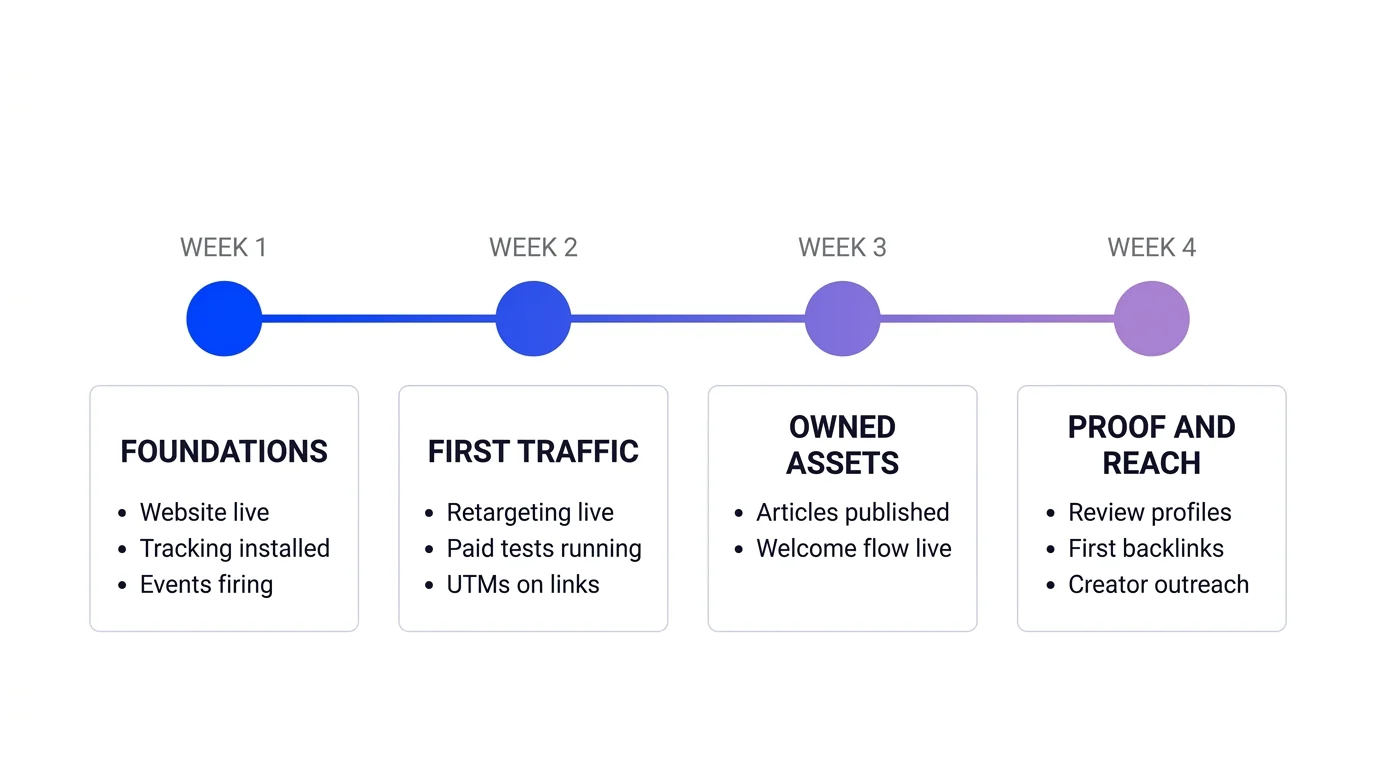
Here is the whole roadmap on one calendar. Each week has a theme, a short list of things that ship, and one gate you check before moving on. Work down the weeks in order, because every week depends on the one before it.
| Week | Theme | What ships | Gate before you move on |
|---|---|---|---|
| Week 1 | Foundations | Website live, tracking installed, conversion events firing | You can see a test lead land in analytics |
| Week 2 | First traffic | Retargeting live, two or three paid tests running, UTMs on everything | At least 100 real visitors, each attributable to a source |
| Week 3 | Owned assets | Five to ten articles published, five-email welcome flow live | Search Console has indexed your pages, flow sends on signup |
| Week 4 | Proof and reach | Directory and review profiles complete, first backlinks, creator outreach sent | You have a baseline number for every channel you started |
That table is the deliverable. If you copy nothing else from this page, copy those four rows into a document, put a name and a date next to each item, and you have a real marketing roadmap rather than an intention.
How do you create a marketing roadmap for a startup?
Build it backwards from the one number you need to learn, not forwards from a list of tactics. A startup roadmap has a different job from an enterprise one: you are not executing a known plan, you are buying information about which channel and which message work. That changes what belongs on it.
Four rules keep a startup roadmap honest.
- Sequence by dependency, not by priority. Tracking before traffic, traffic before optimisation, proof before outreach. A roadmap that starts with the most exciting task usually stalls in week two.
- Put a gate at the end of every week. A gate is a specific observable thing, like "a test lead appeared in analytics", not a feeling like "the site is nearly ready".
- Name an owner per row. In a two-person company this feels silly and still prevents the most common failure, which is a task that belongs to everyone and happens to nobody.
- Leave one row empty on purpose. Something will break, and a roadmap with no slack becomes fiction by day nine.
The nine steps below fill in those four weeks. Each one carries a rough budget and a time box, so you can see the whole climb before you start. None of it needs a growth team or a trust fund, though it does need a written plan behind it. Nine tactics with no thesis is a to-do list, not a roadmap.
The 9-step lean marketing launchpad
Step 1: Put up a fast, credible website
- Action: Start from a template rather than a blank canvas. A builder like Webflow gets you a real, customisable site in days, not weeks. Fill it with your core message, your visuals, and the essential pages: home, features or services, pricing, about, contact.
- Why: Custom code can wait. You need a credible site today so you can test your value proposition and capture leads while you still have the energy to look.
- Pro tip: Put your product or app on your main domain rather than a subdomain like app.yourdomain.com. It pools your authority in one place instead of splitting it.
- 💸 Budget: $50 to $150 for a theme. Roughly $0 if you customise it yourself, or $300 to $700 if you hand it to someone who does this for a living.
- ⌛ Time: 3 to 4 days.
Step 2: Build your data cockpit
- Action: Install Google Tag Manager as the control panel for every tracking script, then wire up the essentials through it:
- Google Analytics 4: set up the events that actually matter, like lead submissions and purchases.
- Ad pixels: add the pixel for any platform you plan to test, so you can measure conversions and build retargeting audiences.
- Session replay: a free tool like Microsoft Clarity lets you watch real visits and spot exactly where people get confused.
- UTM discipline: tag every marketing link with consistent UTM parameters so analytics can tell you which campaign earned which result.
- Why: Running marketing without tracking is driving blindfolded and bragging about your speed. This setup is the windshield.
- 💸 Budget: $0 if you do it yourself, around $200 to outsource the setup.
- ⌛ Time: 1 to 2 days.
Step 3: Set up the boomerang, also known as retargeting
- Action: Spin up around five simple, benefit-led ad variations (a banner and a line of text each) aimed at people who visited and left. Aiter can draft the copy and the banner creatives in your brand colours in one pass, so you are not learning a design tool at 11pm. Run them at a modest $5 to $10 a day across the Google Display Network and Meta.
- Why: Almost nobody buys on the first visit. Retargeting is the polite tap on the shoulder that brings them back. Because you are reaching people who already met you, it tends to convert far better than cold display, for a fraction of the spend. Start small, watch what lands, then pour budget into the winners.
- 💸 Budget: roughly $150 to $300 a month to start.
- ⌛ Time: 1 to 2 days.
Step 4: Open a few cheap traffic streams with PPC
- Action: Launch small ad campaigns on channels known for sharp targeting or lower costs, with separate ad sets testing different angles: a pain point, a benefit, a specific audience.
- Why: The goal right now is learning, not scale. You need fresh visitors to pressure-test your message, validate who your buyer really is, and fill those retargeting lists, all without torching your budget.
Smart channels for early tests:
| Channel | Why it fits a lean test |
|---|---|
| Reddit Ads | Hyper-specific subreddit targeting, strong for niche B2B and technical audiences |
| Microsoft Ads (Bing) | Often cheaper clicks than the big search engine, with an older, desktop-heavy audience |
| Long-tail search | Bid on three-plus word phrases with clear intent and softer competition |
| Quora Ads | Reach people literally asking the question your product answers |
- 💸 Budget: $500 to $1,000 a month, scaled to your appetite for learning and risk.
- ⌛ Time: 2 to 4 days.
Step 5: Lay the SEO groundwork
- Action: Publish five to ten genuinely helpful articles that answer the questions your audience is already typing. If you are short of angles, there are six repeatable ways to find content ideas that start from evidence. Nail the basics of on-page SEO (clear title, sensible headings, one main idea per page) and submit them to Google Search Console.
A simple distribution checklist:
-
✅ Share each piece on your company profiles
-
✅ Link to it from your email sequence
-
✅ Drop a genuinely useful snippet in relevant communities (add value, do not spam)
-
✅ Repurpose the best points into social posts and threads
-
Why: This is how you start building topical authority, earn indexable pages around real keywords, and give your social channels something worth posting.
One month in: check which articles earned traffic, pick the top two or three, and make them genuinely great. Add your own insight, fresh examples, original visuals, and a sourced statistic or two. Depth is what keeps a page ranking.
- 💸 Budget: $10 to $40 in tooling.
- ⌛ Time: 1 to 2 days to draft and start distributing.
Step 6: Welcome new users with an automated email flow
- Action: Set up a short, five-email welcome sequence for new sign-ups.
- Why: The days right after sign-up decide whether someone sticks. A good sequence guides them to value, reinforces why they chose you, and builds the relationship past the first click. For SaaS and B2B products this is the highest-leverage row on the whole table, because activation happens here or it does not happen at all.
A value-first sequence:
| Timing | Focus | |
|---|---|---|
| 1 | Day 1 | Welcome and restate the core value. Point them to a quick-start resource. |
| 2 | Day 3 | Show one key benefit plus a tip that delivers an early win. |
| 3 | Day 7 | Share a customer story or testimonial to build trust. |
| 4 | Day 10 | Answer a common question and remove a point of friction before it bites. |
| 5 | Day 14 | Offer more value: a useful guide, a recording, a sharp blog post. |
Rule of thumb: every email should give something, not just ask for the sale.
- 💸 Budget: $0 to $100 for an email tool.
- ⌛ Time: 1 to 2 days.
Step 7: Earn a few good backlinks
- Action: Acquire a small, careful set of backlinks from genuinely relevant sources: niche directories, respected blogs, an industry association if you can swing it. Quality and relevance beat volume every time.
- Why: For a brand-new site, a handful of credible links tells search engines you belong in your niche. A small, real boost beats a hundred spammy ones that get you penalised.
- 💸 Budget: $100 to $200.
- ⌛ Time: 1 to 2 days of research and outreach.
Step 8: Build credibility hubs and gather proof
- Action: Set up complete, detailed profiles on the platforms your industry trusts. For many tech and SaaS businesses that means review sites like G2, plus listings like Crunchbase and Product Hunt. Then ask happy early users for honest reviews.
- Why: These profiles are third-party validation you do not have to write yourself. A complete, well-reviewed presence on the sites buyers already check lifts discovery, builds trust, and earns you a few solid backlinks along the way. It also feeds the AI assistants, which assemble "best tool for X" answers largely from third-party pages rather than vendor sites, so the same work buys you visibility inside AI answers.
- 💸 Budget: mostly your time.
- ⌛ Time: 3 to 4 days to set up profiles and chase reviews.
Step 9: Get people talking with micro-influencers
- Action: Find, vet, and team up with three to five micro-influencers (roughly 5,000 to 50,000 followers) who genuinely fit your audience.
How to find and vet them:
- Search smart: use hashtags and keyword searches on the platforms your buyers live on, and look at who your ideal customers already follow. On Instagram profiles the tagged and saved tabs tell you more about fit than the follower count does.
- Vet honestly: check that engagement looks real, not bought, and that their content and values actually match yours.
How to collaborate:
-
Make outreach personal: reference their specific work and explain why this fits their audience, not just yours.
-
Brief clearly, then let go: set the goal and key message, then trust them to make it sound native.
-
Why: A niche creator with a small, engaged following often drives better-qualified attention than a big name with a bored one, usually at a far friendlier price.
-
💸 Budget: $800 to $1,400 and up, depending on scope.
-
⌛ Time: 5 to 10 days of research and personal outreach.
What should you check at the end of each week?
Check the gate, not the mood. Each week has one question with a yes-or-no answer, and a couple of numbers that tell you whether the next week is worth starting.
| End of | The one question | Numbers worth reading |
|---|---|---|
| Week 1 | Did a test lead reach analytics with the right event name? | Page load time, mobile rendering, form completion |
| Week 2 | Can you name the source of every visitor? | Visitors by source, cost per click, bounce by landing page |
| Week 3 | Are your pages indexed and is the flow sending? | Pages indexed, email open and click rate, time on page |
| Week 4 | Do you have a baseline for every channel you started? | Cost per lead by channel, retargeting return rate, reviews collected |
If a gate fails, fix it before starting the next week. This is the discipline the whole plan lives or dies on, because a broken tracking event in week one quietly invalidates every number you collect in weeks two through four.
Week 1 gate: is the foundation actually done?
0 of 8 · Stay in week 1. Everything downstream depends on this, and none of it is expensive.
One gate deserves a lower bar than people set for it. Week 3 asks whether your pages are indexed, not whether they rank, and those are different events. Google's own crawling and indexing documentation is explicit that it makes no predictions or guarantees about when a URL will be crawled or indexed, that the commonest reason a new site is missing is simply that it is new, and that being indexed does not imply showing up in results. So request indexing of your homepage, confirm the pages exist in Search Console, and do not read anything into your position in month one.
What if 30 days is not realistic for you?
Then run it as a 90-day roadmap with the same order and nobody will be worse off. The sequence is the valuable part; the calendar is a forcing function, not a rule. Three common situations and what to change:
- You have a day job. Do one week per fortnight. The plan becomes eight weeks and loses nothing except momentum, which you can rebuild by keeping the gates.
- Your product is not finished. Do weeks 1 and 3 only. A site with tracking and a handful of articles is a useful asset while you build, and neither depends on having something to sell today.
- Your strategy is still moving. Then a roadmap is exactly the wrong artifact for months two and three, and the right one for month one. Commit to the foundations, which do not change whatever you end up selling, and leave weeks 2 and 4 as placeholders until the positioning settles.
Your 30-day roadmap: rough investment
These are planning estimates, not quotes. Your real numbers depend on how much you do yourself.
| Category | Estimated cost |
|---|---|
| One-time setup | ~$450 to $1,350 |
| First month operations | ~$1,450 to $2,700 |
| Total first month | ~$1,900 to $4,050 |
| Ongoing monthly minimum | ~$650 to $1,300 |
Where your head should be: build the systems, launch the tests, gather baseline data, learn how people behave. This month is for learning, not for profit. Consistent return usually shows up months later, so do not judge week one by its revenue.
For context on how unusual that spend is, Gartner's 2026 CMO Spend Survey of 401 marketing leaders found budgets sitting at 7.8% of company revenue. Almost all of those respondents run billion-dollar companies, so do not use it as your benchmark. It is useful for the opposite reason: early-stage companies spend a far larger share of revenue on marketing, and that is normal rather than reckless.
Three principles that keep this lean
- 🔄 Build, measure, learn. Treat every ad, email, and article as an experiment. Look at the data, then change one thing.
- 🚀 Ship before it is perfect. An 80% launch you can learn from today beats a flawless campaign you publish in three months, by which point the market moved.
- 🎯 Stay focused. Start with a few channels you can actually measure. You can always add more once something works. You cannot un-spread yourself thin.
Frequently asked questions
Do I really need all nine steps in 30 days?
No. The order matters more than the calendar. Get the site, tracking, and retargeting live first, since everything else feeds on them. If a step does not fit your business, skip it and move on rather than delaying the whole roadmap for a row that was never going to apply to you.
What if my budget is basically zero?
Do the free steps with sweat instead of cash: the site customisation, the tracking setup, the articles, the directory profiles, and the review requests. That is five of the nine steps and it produces a genuinely working foundation. Add paid channels the moment you have a little to test with.
When will this actually make money?
Probably not this month, and that is fine. Month one builds the engine and the data. Returns tend to compound over the following quarter once you know which channels and messages work, and the paid channels will show a signal long before the owned ones do.
What is the 70/20/10 rule in marketing?
Put 70% of your budget into channels already proven to pay, 20% into emerging channels showing real promise, and 10% into experiments you can afford to lose. It is a portfolio rule for after your first month, once you actually have a proven channel to put the 70 into. Before that, the whole budget is the 10.
How many marketing channels should I start with?
Two or three, and no more. The whole point of the roadmap above is to buy information cheaply, and you cannot read a signal from six channels running at a hundred dollars each. There is a longer argument about which channels are worth the money, and it comes down to picking by business type rather than by fashion.
Is a marketing roadmap the same as a marketing plan?
Not quite. A plan says what you intend to achieve and why. A roadmap says what ships, in what order, by when, and who owns it. Investors usually ask for the plan. The team needs the roadmap, and the roadmap is the one that gets anything built.
You built the engine. Now learn to fly it.
In about a month you have a working marketing foundation: systems that attract visitors, track behaviour, win back the ones who left, nurture the ones who stayed, and measure all of it. That is not the finish line. It is a launchpad.
From here, the job is to use the data you are now collecting. Sharpen the messaging, fix the leaky landing pages, retarget smarter, and pour budget into whatever is quietly working.
If the content side is the bottleneck, that is the easy part to hand off. Aiter drafts the ad copy, the welcome emails, and the starter articles this plan runs on, all from your URL, so your 30 days go to strategy and learning instead of staring at empty text boxes. Now go build, measure, and learn.