Content ideas come from six places, and only one of them is your imagination. Competitor data, the conversations your audience is already having, search data, direct questions to customers, industry shifts, and AI drafting against your own site. All six are habits rather than flashes of insight, and all six can be running by Friday.
The harder problem is the one nobody writes about. Once the methods work you have forty ideas and room for four, and choosing badly wastes the month. So this covers how to get content ideas out of each source, then how to decide which one goes next, then how to tell whether it worked.

What separates an idea from a converting idea
Plenty of topics get clicks. Far fewer get customers. The difference is intent, so judge every idea against three filters before it reaches your calendar.
Does a buyer genuinely care about this? Can you say something specific and true that most competitors are fudging? Does it connect, even loosely, to a reason someone would choose you? A topic that fails all three belongs on the blog of someone who is not trying to grow a business.
Hold onto those three. They come back later as a scoring tool.
The six methods at a glance
| Method | Time to first idea | Effort to keep running | Best for |
|---|---|---|---|
| Competitor data | An afternoon | Monthly | Finding proven demand you are missing |
| Social listening | A week | Weekly, 30 min | Exact wording and real emotion |
| Search data | An hour | Monthly | Volume and buying stage |
| Customer questions | Days | Ongoing, free | Objections that block sales |
| Industry news | Immediate | Daily scanning | Authority and timing |
| AI against your site | Minutes | None | Breaking the blank page |
Nobody runs all six. Two done properly beats six done badly, and the first two rows are where most teams should start.
1. How to get your next content ideas from competitor data
Competitor data is the fastest route to proven demand, because your rivals have already spent money discovering what your shared audience responds to. You are not looking for their best posts to imitate. You are looking for the topics that clearly work and the specific places they did the job badly.
This is a content gap analysis, and here is how to do one. It takes an afternoon the first time and an hour a month after that.
- List five to eight real competitors. Direct ones, not aspirational ones. A local clinic competes with nearby clinics, not with a national chain.
- Pull the pages that earn them links and shares. Those are the proven themes. Volume of posts tells you nothing; a single heavily linked piece tells you a lot.
- Build the content gap list. Two columns: topics several of them cover that you do not, and topics none of them cover at all. The first column is catch-up work with demand already proven, while the second is where you can own something outright.
- Read the comments under their most popular pieces. This is the part almost everyone skips and it is the richest of the four. People announce exactly what an article failed to answer. An unanswered question under a popular post is a brief handed to you for free.
- Find the thin pages. A rival's 600-word overview of a topic they touched once and abandoned is an invitation to publish the version that settles the question.
The output is not a list of titles. It is a list of jobs: this topic has demand and three weak answers, so write the definitive one.
A worked example of the fourth step, because it is the one people doubt. A rival publishes a piece on tenant screening. Under it, four separate people ask some version of "but what can you legally ask for in my state?" The rival never replies. That is not a comment thread. That is a state-by-state screening guide with proven demand and zero competition, and it took ten minutes of reading to find.
If you would rather not do the gathering manually, an AI competitor analysis tool runs the same pass across verified competitors and returns positioning, themes and gaps with a named source per claim. The reading of the comments is still on you. That part does not automate well, which is exactly why it stays valuable.
2. Social listening: mine the conversations already happening
Social listening gives you the words your audience actually uses, which search tools flatten and surveys sanitise. Your audience is out there right now telling the internet what confuses, annoys and excites them, in comments, niche subreddits, Slack and Discord rooms, and the quote-posts on X where people say what they really think.
Read those rooms on purpose, hunting three things: the questions that keep coming back, the exact phrasing people use for their problem, and the moments where someone gets unexpectedly emotional. A recurring question is a headline. The phrasing is your hook and your search targeting. The emotion tells you which topics carry real energy.
Make it concrete. Say you run a property management tool and the same complaint surfaces in landlord forums every week: tenant screening is a legal minefield and nobody trusts their own process. That is not one post. That is a screening checklist, a piece on the laws people get wrong, a teardown of application red flags, and a calculator for what a bad tenant costs. One overheard frustration, a month of content.
Worth noting how well this format travels. Search for almost any "how do I find content ideas" question and forum threads rank on the first page, above the polished vendor guides. People trust practitioners describing what they actually did. Write like that.
3. Search data: follow the trail your audience leaves
Search data tells you what people type when they think nobody is watching, which is usually more honest than what they say out loud. Every query is a small confession of intent, and unlike listening, it comes with volume attached.
Start with the questions. The People Also Ask box on any result is a live feed of what else your audience wonders about a topic, and each entry is a ready-made subheading or a standalone post. Copy the phrasing exactly rather than tidying it up; the tidy version is not what anyone types.
Then watch the modifiers people attach to your category. Words like best, alternative, free and pricing each signal a different stage of intent and deserve their own piece. If your category is visual at all, run the same check inside Pinterest search, whose autocomplete is a keyword tool most marketers never open. Someone searching "alternative" is further along than someone searching "what is".
Then mine the data you already own, which is the part teams forget they have. Your site search bar is a transcript. Visitors are telling you, in their own words, exactly what they could not find, and nobody reads it. Search Console shows every query where you already appear, including the ones you never targeted. If you rank at position 14 for something you never wrote about, that is a page waiting to be written.
How do I turn audience research into content topics?
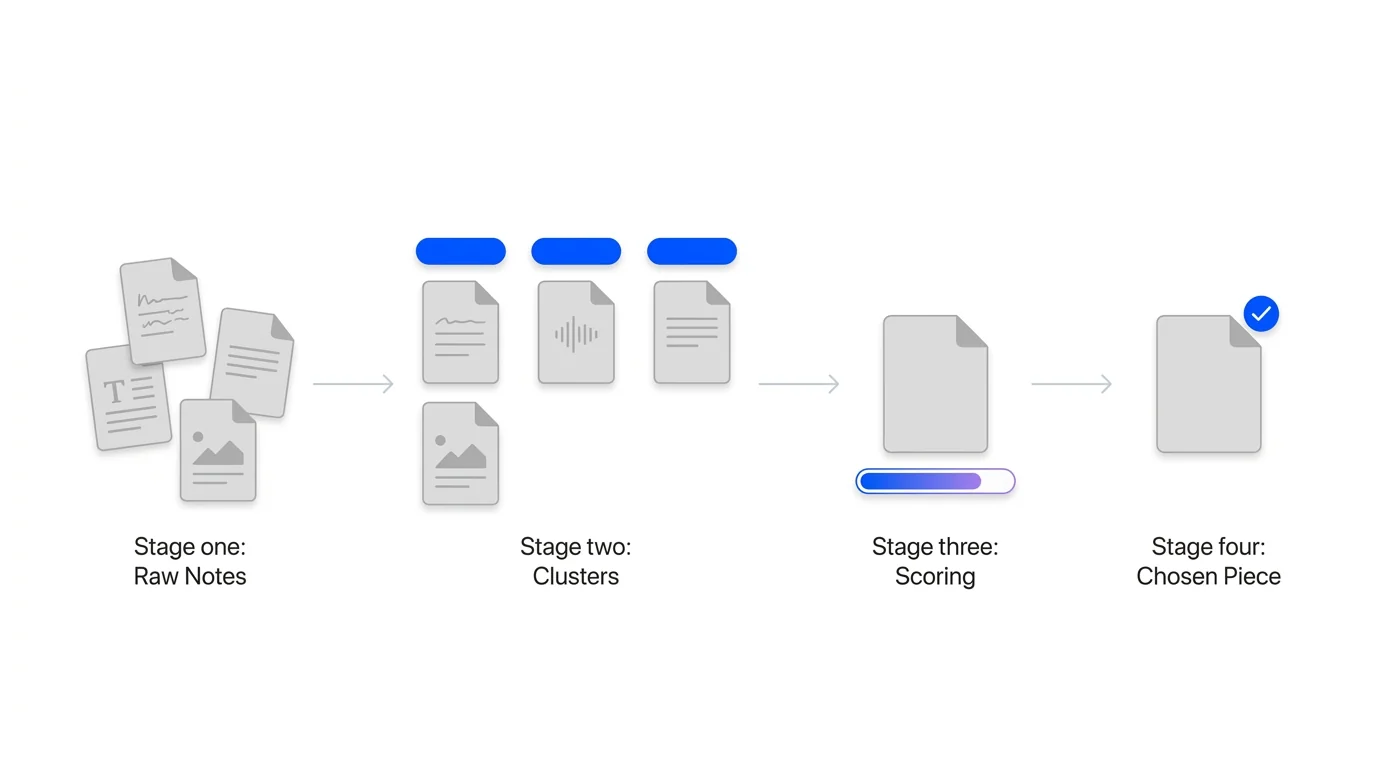
Turn research into topics by grouping raw notes by the question behind them, not by the source they came from. A forum complaint, a support ticket and a search query can all be the same underlying question wearing different clothes, and treating them separately gives you three thin posts instead of one strong one.
The mechanic is simple enough to do in a spreadsheet.
- Dump everything into one column: quotes, queries, ticket subjects, survey answers. No editing.
- Beside each, write the question the person was really asking, in their words.
- Sort by that column. Duplicates cluster on their own.
- Any cluster with three or more entries from two or more sources is a topic with evidence. One entry from one source is a hunch.
- Name each cluster as a title someone would click, then score it.
That third step does the work. Evidence from two independent sources is the difference between a topic and a guess, and it costs you nothing but sorting.
4. Customer questions: ask the people who already chose you
The fastest research method is also the most skipped, probably because it feels too obvious to count. Ask your audience what they want to learn. They usually tell you.
The trick is making the answer effortless. Vague prompts like "what content would you like to see?" get vague, useless answers. Specific ones perform: offer a short list of topics and ask people to rank them. Email recent buyers and ask what nearly stopped them from purchasing, because that objection is a piece of content that pays for itself. We wrote up how to turn those answers into messaging in need-based versus objection-based ads.
Keep it brief and frequent. A steady trickle of small sharp questions beats one annual survey everybody ignores. And listen to sales and support, who run an informal version of this survey every single day and rarely get asked what they heard.
5. Industry news: be the one who explains what it means
When something shifts in your industry, your audience does not want the headline. They already saw the headline. They want someone credible to tell them what it means and what to do on Monday.
That is the whole play, and most competitors fumble it by stopping at the recap. Set up alerts for the people who break news in your space, then add the layer nobody bothers with: translation. What does this actually change for your reader? What should they do differently? What is overhyped and safe to ignore?
Speed gives you a window, but the value sits in the interpretation. A thoughtful take two days later beats a breathless one two hours later that just restates the announcement.
6. AI against your own site: skip the blank page
AI is worth using at the gathering stage, where it turns an afternoon into a couple of minutes, and it is worth distrusting at the judgement stage, where it has nothing to judge with.
A generic chat prompt gives you generic topics, because it knows nothing about you. Pointing a tool at your actual site is different: Aiter reads what you sell and how you talk about it, folds in research on your competitors and audience, then returns topics shaped for specific channels, from a LinkedIn point of view piece to a YouTube concept to a blog post built around real search intent. You start with a list instead of an empty calendar.
One thing worth knowing if you care about being cited by AI answers rather than only ranking in them. In the Princeton generative-engine-optimization study presented at KDD 2024, adding statistics improved visibility in AI answers by roughly 41% and adding quotations by roughly 28%, while keyword stuffing measured negative. That is a property of how you write the piece, not of who drafted it. We went deeper in getting cited by AI Overviews and ChatGPT.
Which idea should you publish first?
Publish the idea with the most evidence behind it and the shortest path to finished, not the one you find most interesting. Those are rarely the same, which is why a scoring step is worth the two minutes it costs.
Score one idea at a time. Anything below the halfway mark goes back to the backlog rather than into the calendar.
Should this idea go next?
Answer all 5 to get a verdict. 0 of 5 so far.
Two rules make the scoring honest. Score before you fall in love with the draft, because afterwards every criterion mysteriously improves. And keep the effort question in, because a nine-out-of-ten idea that takes a month loses to two eights that ship this week.
Then balance the calendar. Mix timely pieces that ride current interest with evergreen ones that compound for years. Living on either alone leaves growth on the table.
How to tell whether an idea worked
Judge an idea on impressions first, not traffic, and give it eight to twelve weeks before deciding anything. Impressions tell you whether the topic has demand. Clicks tell you whether your title promised the right thing. Conversions tell you whether the topic was connected to your business at all. Those three failures need three different fixes, and traffic alone cannot tell them apart.
What to check, in this order:
- Impressions near zero. The topic has no audience, or you have no authority on it yet. Not a writing problem.
- Impressions healthy, clicks poor. You are ranking for something your title does not promise. This is the cheapest fix in content and the one most often left undone.
- Clicks healthy, no conversions. You attracted readers with no reason to buy. Keep the page if it earns links, but stop building more like it.
- Everything healthy. Write three more on the same theme immediately. Demand clusters.
We can be specific about the second row because this page was in it. Before this rewrite, it had collected 1,731 impressions for 2 clicks at an average position of 22, and 219 of those impressions came from one query about pulling content ideas from competitor data. The page never once used the phrase "competitor data". Google worked out what it was about; the title never told anyone. That gap between what a page ranks for and what it says it is about is the single most common reason a decent article underperforms.
What to do when an idea underperforms
Rewrite it, merge it, or delete it. Those are the three options, and doing nothing is the expensive fourth one.
Rewrite anything with real impressions and a bad click rate. Demand is already proven, so you are fixing the promise rather than the premise. Start with the title and the first hundred words.
Merge near-duplicates into one strong page and redirect the rest. Three thin posts on one topic compete with each other and none of them wins.
Delete pages with no impressions and nothing original to say, and return a proper 404. This feels like destroying an asset. A page nobody reads is not an asset, and at volume it looks like the pattern Google's spam policy calls scaled content abuse, which we covered in Google's official stance on AI-generated content.
Give a rewrite the same eight to twelve weeks before you judge it. Recrawling alone can take anywhere from a few days to a few weeks according to Google's own documentation, and reassessment happens after that. The same page notes that requesting a recrawl repeatedly for one URL will not get it crawled any faster, which is worth knowing before you spend an afternoon in Search Console clicking the button.
Frequently asked questions
Where can I get content ideas from?
The six sources above: competitor content and its comment threads, the communities where your audience talks, search data including People Also Ask and your own Search Console, direct questions to customers and to your support team, industry news that needs translating, and AI drafting against your own site. Everything else is a variation on one of those.
Which methods reveal the specific questions an audience asks?
Three do it directly. People Also Ask and search autocomplete give you the exact wording people type. Comment threads under competitor content give you what an article failed to answer. Your own support tickets and site-search logs give you the questions people ask when a purchase is already at stake, which are the most commercially useful of the three.
How many content ideas should I generate at once?
Generate far more than you will use, then cut hard. A backlog of thirty rough ideas you can rank and discard beats three precious ones you feel obliged to publish. Quantity in the gathering phase is what makes quality possible in the choosing phase.
What is the 70-20-10 rule in content?
It is a way of splitting your calendar by risk: about 70% of what you publish should be formats and topics you already know work, 20% should be adjacent experiments, and 10% should be genuine long shots. It stops a calendar becoming either monotonous or entirely speculative. Treat it as a rough allocation rather than a law.
What are the 5 C's of content?
Clarity, consistency, creativity, credibility and customer-centricity. Useful as a review checklist before publishing, not as an idea-generation method. Ideas come from evidence; the five C's tell you whether you executed one properly.
What if my industry feels too boring for interesting content?
There are no boring industries, only boring angles. Every field has frustrated customers, contested opinions and expensive mistakes people keep making. The methods above surface those tensions, and tension is what makes a piece worth reading. That goes double when you sell your own expertise: what feels obvious to a coach or consultant is usually the exact thing a client has been quietly getting wrong for years.
Can AI handle my entire content ideation process?
It handles the heaviest and most repetitive part well: scanning your business and its market, then producing a broad set of relevant topics quickly. What it cannot supply is the lived experience, the opinion and the proof that make a piece worth quoting. Use it to clear the blank page, then do the human work on top. Our AI blog post writer is built around that split on purpose.
How often should I run these methods?
Competitor data and search data reward a monthly pass. Social listening works as a weekly half hour rather than an occasional deep dive. Customer questions arrive continuously if you set up any route for them. Industry news needs daily scanning but only occasional writing.
Stop guessing what to publish
A content engine should not run on inspiration, because inspiration does not show up on deadline. Run two of these methods properly, sort what comes back by the question behind it, score before you write, and you will have more good ideas than time to write them.
If the gathering is the part eating your week, point Aiter at your site and let it turn what you already do into a queue of channel-ready topics. Then bring the part only you can: a reason for someone to choose you.