Meta's limits are different in kind from Google's. Nothing gets rejected for being long. It gets hidden behind "See more", which most of the feed never taps, and your argument dies quietly below a fold nobody scrolls past.
So the numbers to write to are truncation points: 125 characters of primary text, 40 for the headline, 30 for the description.
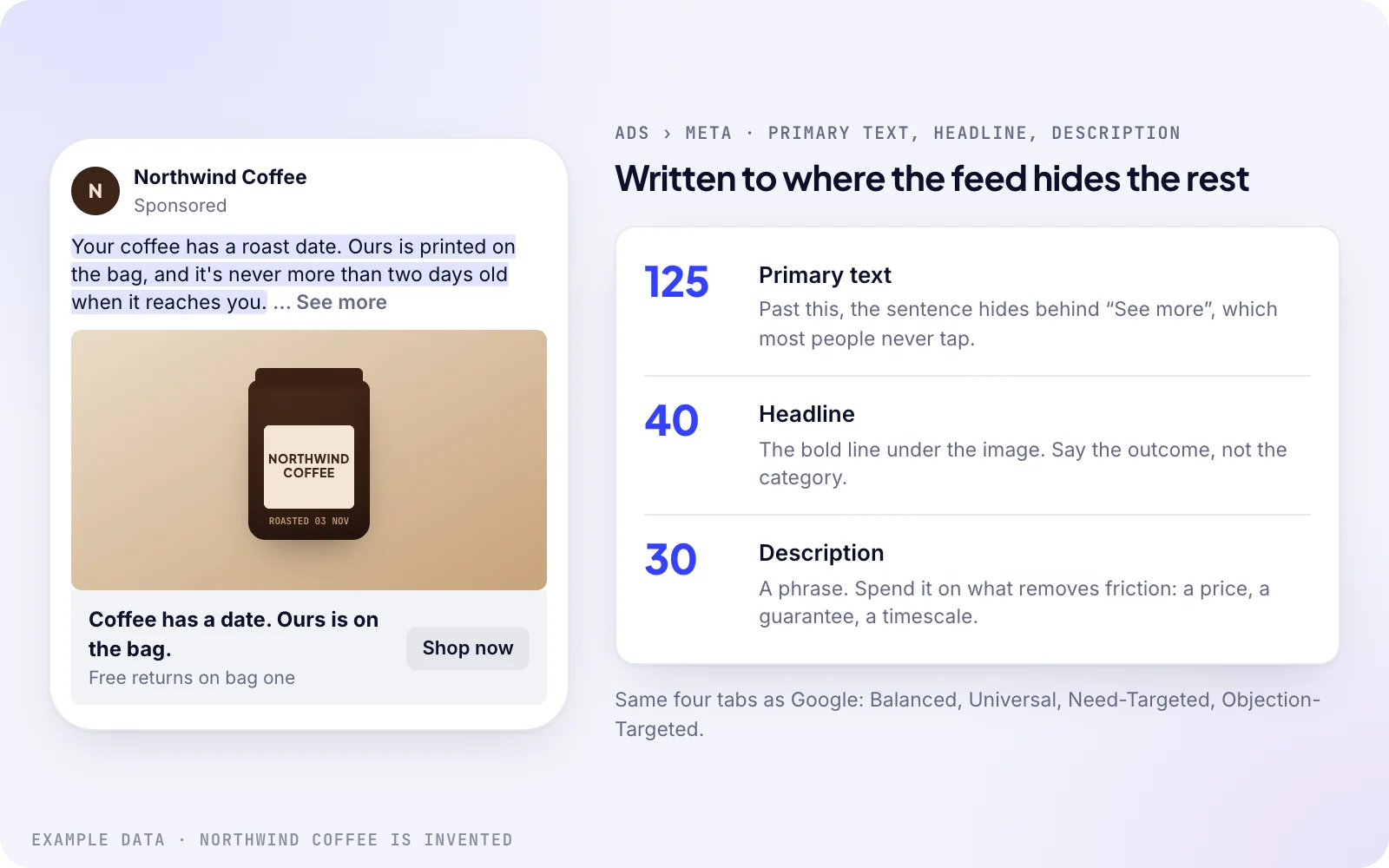
The three fields and what each is doing
Primary text sits above the image and carries the argument. The first sentence is doing ninety percent of the work, because it is the only part guaranteed to be read.
Headline sits under the image in bold. Forty characters. Say the outcome, not the category.
Description is the smallest field and the most often wasted. Thirty characters is a phrase, so use it for the thing that removes friction: a price, a guarantee, a timescale.
Headlines and primary text come in the same four tabs as Google: Balanced, Universal, Need-Targeted and Objection-Targeted.
Writing for a muted, half-attentive audience
Meta ads are read by people who did not open the app to buy anything, and that single fact should shape how you judge every line of generated copy, starting with whether the first one survives a thumb that is already moving.
Read the first line on its own. If it needs the second line to make sense, it will not get one.
Read it as though a friend's holiday photos are immediately above it, because they are.
Check that it says something specific in the first six words. "Struggling with X?" is a formula the feed has been trained to skip since roughly 2014.
Pairing copy with creative
Meta is a visual placement, and the copy is the smaller half of the job. Banners generate in your brand colours from your brief, for 5 credits each, in 16:9 and square, and you can hand them reference images: real product photography, your logo, packaging.
Generate the banner and the copy as a pair, then look at them together at phone size before you decide anything. A headline that works in a text editor and disappears against your own image is a common and avoidable mistake.
Angles worth generating separately
Rather than regenerating the same brief repeatedly, change what you are asking for.
One batch selling the outcome, another answering the top objection from your review research, and a third at a higher creativity level for the scroll-stopper. Three different arguments beat nine variations on one, and Meta's own testing works better when the variants genuinely differ.
Frequently asked questions
Does this cover Instagram too?
Yes. Meta ad copy runs across Facebook and Instagram placements, and Instagram has its own section for organic posts with image concepts.
Are longer primary texts ever right?
Sometimes, for warm retargeting audiences who already know you, where a longer story can work. The generated copy targets the truncation point because that is the safer default for cold traffic.
Can I generate ads in another language?
Yes. Each campaign writes in the language picked when it was created, from 81 options, whatever language the app itself is in. For ads in a second language, start a second campaign in that language.