The AI video ad generator that reads your site before it writes a word
Paste a URL. Aiter finds the argument worth making, writes the hook, storyboards every scene, then films it. What lands is a finished MP4 with voiceover and a score, cut for the feed you're buying.

Aiter is free to start. Rendering video needs a paid plan.
- 20,000+ marketers signed up
- 4.8/5 on G2
 Funded by the European Union
Three moves. Zero prompt-pong.
Same engine every time: read your site, think strategy-first, generate on-brand. Here is how that plays out.
Paste your URL
Aiter reads the site the way a strategist would and comes back with your positioning, who buys, and what they push back on.

Pick the argument
Concepts arrive with a hook and the claim each one makes, and since two concepts arguing the same thing are counted as one idea, what you end up comparing is a set of genuinely different angles rather than five rewordings of the same pitch.

Direct the shots
A scene table with timing, camera moves, on-screen text and the spoken line. Change any of it. Regenerate a keyframe you don't like.

Render
Voiceover, footage, music and a branded end card, stitched into one MP4. Because this step runs on our servers instead of in your browser, you can close the tab, go and do something else, and come back to a finished file waiting for you.
15s
Longest ad, typed as a number
3
Aspect ratios, briefed per video
4
Review passes before you see it
77
Languages the voiceover speaks
What a concept looks like before anything is filmed
One concept for a trail e-bike we made up. The claim is the part most tools never show you, largely because most tools never decide it, and an ad without a decided claim is just footage with a logo at the end.
Everyone films the descent.
The motor is pointed at the part of the ride people quit on, not the part they post. Aimed squarely at every e-bike ad that sells the way down.
Handheld POV realism. Dust, grip and breath, shot from the bike rather than from a drone hovering above it.
Three beats, bold tone, fifteen seconds, ending on a brand card that holds still.
Sample output. Yours is generated from your own site.
The shot list, before a single frame is filmed
Step three hands you a scene table you can edit: how long each beat runs, where the camera goes, what is written on screen, and the line spoken over it.
- 0:00-0:04

THE FUN PART
Hook
Ground level, wide lens. A knobby tire tears through loose gravel straight at camera, stones flaring in the low sun.
Everyone films the descent.
- 0:04-0:08
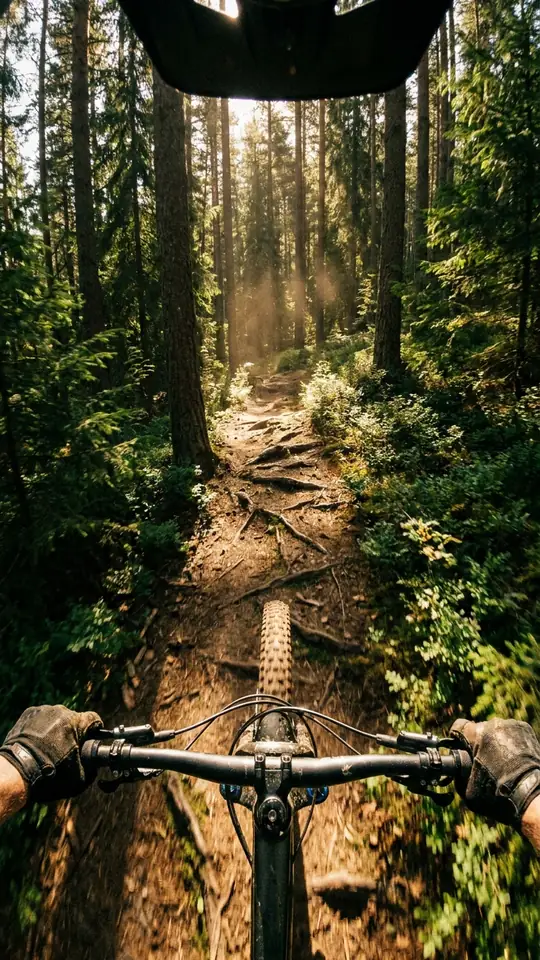
THE OTHER 20 MINUTES
Turn
Straight over the handlebars, helmet mount. A steep rooty climb rising away through pines, light coming down in shafts.
Nobody films the twenty minutes that earn it.
- 0:08-0:12
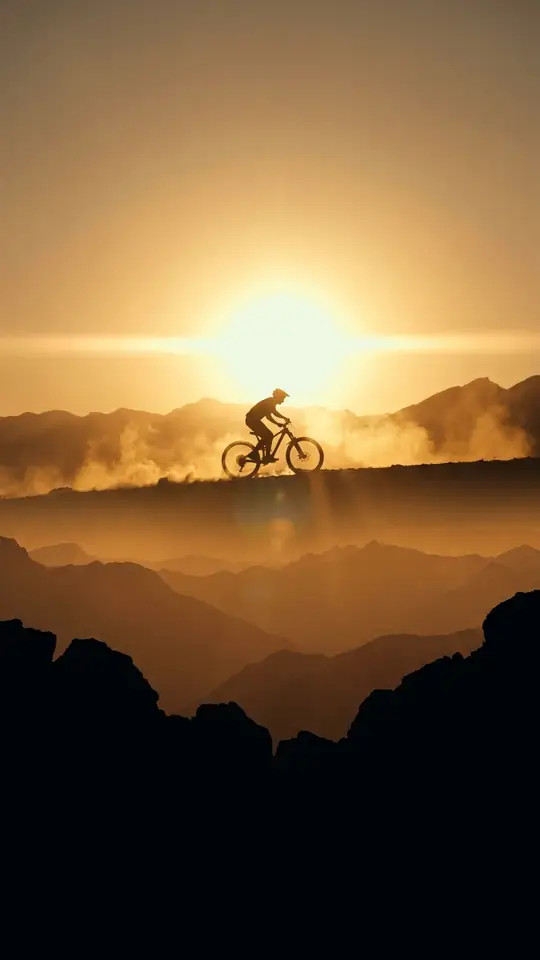
GO BACK UP
Payoff
Long lens, ground level. The rider crests a bare ridge as a silhouette against a huge low sun, dust glowing in the backlight.
This one makes the climb the reason you go back.
- 0:12-0:15

RIDGELINE · Ride the way up
Brand card
Logo on the brand palette over hanging dust. Held still, with no camera move, on purpose.
A worked example for a brand we made up, not a customer campaign.
Why this beats the two things you'd otherwise do
- A shoot, minus the TuesdayA crew, a location and an edit suite costs a week and a budget line. This costs an afternoon, and you can change your mind twice inside it.
- An argument, not a layoutTemplate editors hand you a beautiful container and leave the thinking exactly where it was, which is fine on the days you already know what the ad should argue and expensive on all the others. Aiter picks the claim out of your brief, then builds shots that carry it.
- Editable at every stepRewrite the hook, swap a scene, drop in your own clip, regenerate one keyframe. Nothing locks until the render starts.
- The ad speaks its own languageVoice language is set per video, separately from your interface and your campaign. A German team ships a Spanish ad without touching anything else.
Why it doesn't come out looking generic
Four passes run over every ad. Each one catches a class of problem the pass before it structurally cannot see.
- 1
The script critic reads the story
It checks the claim holds, the beats land in order, and the script hasn't quietly asked the model to do something it always gets wrong. Fine motor work is the classic one. Nobody has yet rendered a convincing shot of a hand writing.
- 2
The frame critic looks at every keyframe
Composition, product placement, and whether the shot actually shows what the scene said it would. A beautiful frame of the wrong thing is a script problem wearing a picture, which is why it gets caught here and sent back a step rather than quietly filmed.
- 3
The clip critic watches the footage
Motion, continuity, objects that slide when nothing pushed them. It can order one retake and only one, because a second usually means the scene needs rewriting rather than refilming.
- 4
Self-heal deals with the boring failures
A reference that won't load, a provider that times out. This pass repairs what it can and refunds what it can't, weighted by how far the job actually got before it fell over.
Three ways to end up with a video ad
Book a crew, wait a week, and hope the hook lands.
Render this afternoon, and rewrite the hook if it doesn't.
A template that fits your logo and nothing else about you.
Shots built from your positioning, your palette and your own product images.
An AI avatar reading a script you had to write yourself.
The script comes out of the brief, so the argument is settled before the camera turns on.
One aspect ratio, then a fight with the export settings.
9:16, 1:1 or 16:9, briefed per video and composed for it.
Fifteen seconds of script that reads out in nine.
The ad's length is the script's length, enforced on the scene table.
The numbers, before you sign up for anything
All of this is what the app does today, and where a plan caps something it gets named here rather than discovered halfway through your first render, which is the worst possible moment to learn it.
What it makes
- Length
- 4 to 30 secondsTyped as a number, not picked from three buttons. Four is the shortest clip the video model produces; past fifteen it loses the thread.
- Aspect ratio
- 9:16, 1:1, 16:9
- Resolution
- 480p, 720p, 1080p720p by default. 480p exists so you can check pacing before paying for the real one.
- Each scene
- Generated, a still, or your own clipOne ad can mix all three. An uploaded clip goes into the timeline untouched.
- Voice
- 10 presets, 77 languagesOr describe the voice you want. Set per video, independent of your interface language.
- Music
- 10 beds, or describe one
- Ending
- Branded end cardLogo, line and call to action, held still on purpose.
What a render costs
- 6 seconds, 720p
- 21 credits
- 15 seconds, 720p
- 50 credits
- 15 seconds, 1080p
- 107 credits
- 15 seconds, 480p
- 35 creditsThe draft pass, for checking pacing.
- The steps before it
- 1, then 2, then 3 per sceneConcepts, script, keyframes. All quoted on screen before you spend them.
- Free plan
- Can't render videoBegin runs to 8 seconds, Advance to 15, Conquer to 30 and 1080p.
A render is charged once, when it starts. One that fails part way refunds in proportion to how far it got.
In the box
- A hook written for the first three seconds
- A scene table with timing, camera moves and the spoken line
- Keyframes you can regenerate one at a time
- Voiceover with word timings, and a score that ducks under it
- A branded end card carrying your logo and call to action
- One MP4, sized for the placement you briefed
Reviews, quoted as written
4.8 out of 5 on G2, stars shown as given, quotes as written.
- 5
Danylo G.
Co-founder, small business
"Being a one-man band, Aiter's like having a marketing agency in my pocket. I generate ad copy for Google and Facebook, and also get ideas for SMM on my TikTok and YouTube."
- 5
Justin D.
SVP, Advertising
"From brand guidelines to video scripts to ad copy and marketing strategy, the output is very thorough. When you download all the information, it's easily a 40+ page PDF. The UI is straightforward, and very easy to navigate."
- 4.5
Anastasia D.
Marketing manager, e-commerce
"I run a small e-shop that sells sports equipment, and Aiter is truly a gem for marketing ideas and content. I use it to get inspiration for both my SMM and PPC."
- 4.5
Aram A.
Journalist, mid-market SaaS
"Less time staring at a blank page means more time actually doing. Also, the results are better than from ChatGPT, Claude etc."
They also say it is a first draft you edit. Everyone who said so still gave it 4.5 or 5.
Read them all on G2Get the first cut before the crew calls back
Paste your URL and see which argument Aiter picks for your product.
5 credits before you even sign up. No card, no strings.