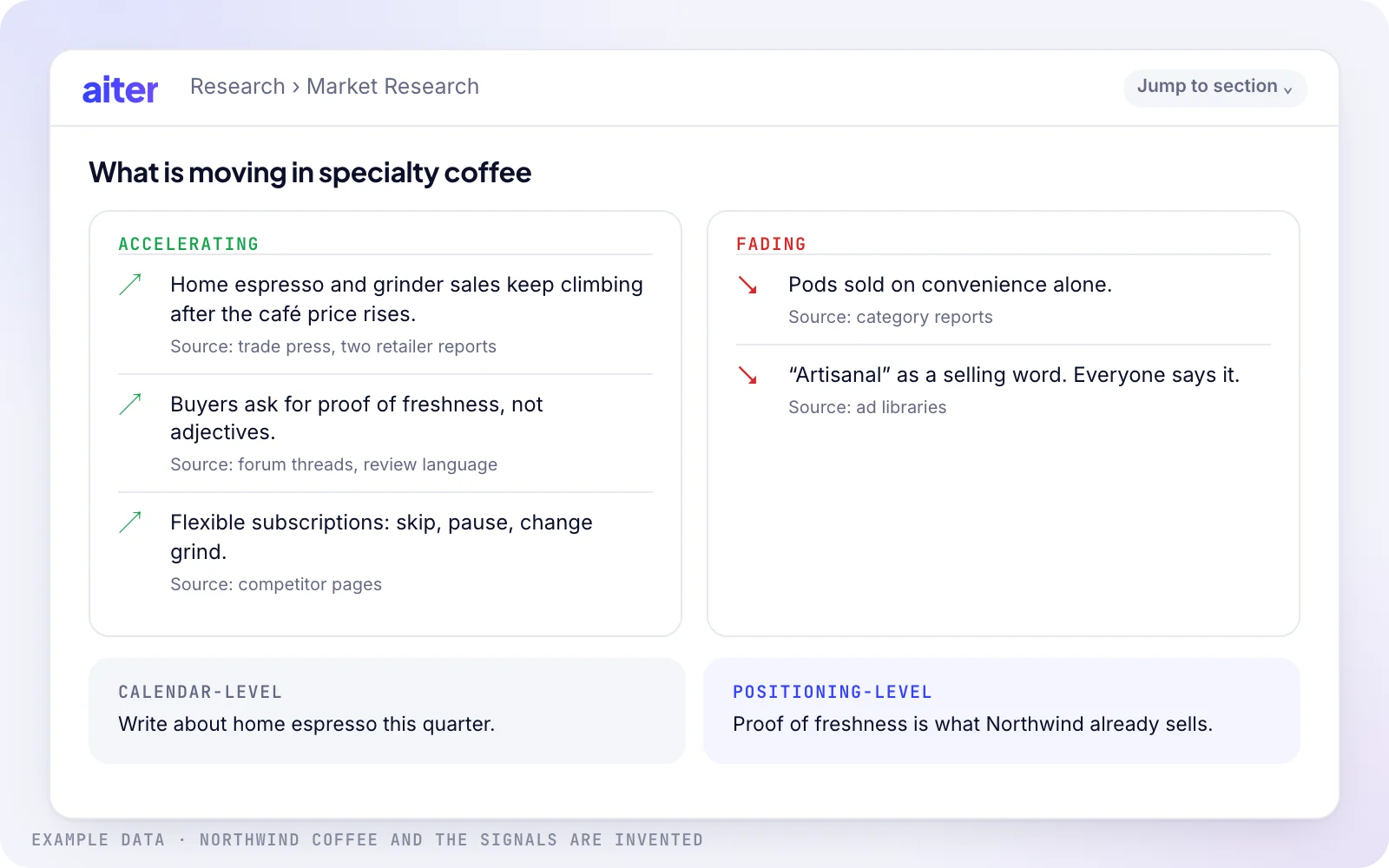
Market trends costs 20 credits and produces a read on the signals shaping your market: what is accelerating, what is fading, where consumer behaviour is moving, and which technology changes are relevant to what you sell.
It has an outline for jumping between sections.
When it earns its 20 credits
Timing is part of your pitch. If your product exists because something changed in the market, the report gives you the language and the evidence for that argument.
You are writing thought leadership. Articles, LinkedIn posts and PR pitches all improve dramatically when they are anchored to a real shift rather than to an opinion. This is the report that supplies the anchor.
Somebody is going to ask you about the market. Investors, a board, a new client. Trend context is the section of the deck people actually read.
When to skip it
If you are trying to fix why your ads sound generic, this is not the report, because competitor and review research move ad copy far more than anything happening at the level of a whole category.
Trends operate at category level. Ad copy operates at the level of one person deciding whether to click. The gap between those two altitudes is why a trends report rarely rescues a weak headline.
Reading it for use rather than for interest
The failure mode here is enjoying the report and doing nothing with it. Two ways to avoid that:
Pick one trend and write one thing against it this week. An article, a LinkedIn post or a landing page angle is enough to find out whether the trend has any pull with your audience before you build a quarter around it.
Then check whether the trend changes your positioning or only your calendar. Most trends are calendar-level: they tell you what to publish this quarter. A rare one is positioning-level and tells you what to be. Knowing which you are looking at prevents a lot of unnecessary rebranding.
Frequently asked questions
How far ahead does it look?
It reports on signals that are visible now and where they appear to be heading. Anything presented as a future state is inference from current evidence, so treat it as a well-sourced opinion rather than a forecast.
Is it region-specific?
It works from what your brief says about your market. A brief that names your geography produces a more locally grounded report than one that does not.
Does it replace an industry report I would buy?
No. It is fast, sourced and free of a four-figure invoice, and a purchased industry report has survey data behind it that the public web does not carry. Different tools.