Two different language settings exist and confusing them causes a predictable half-hour of frustration.
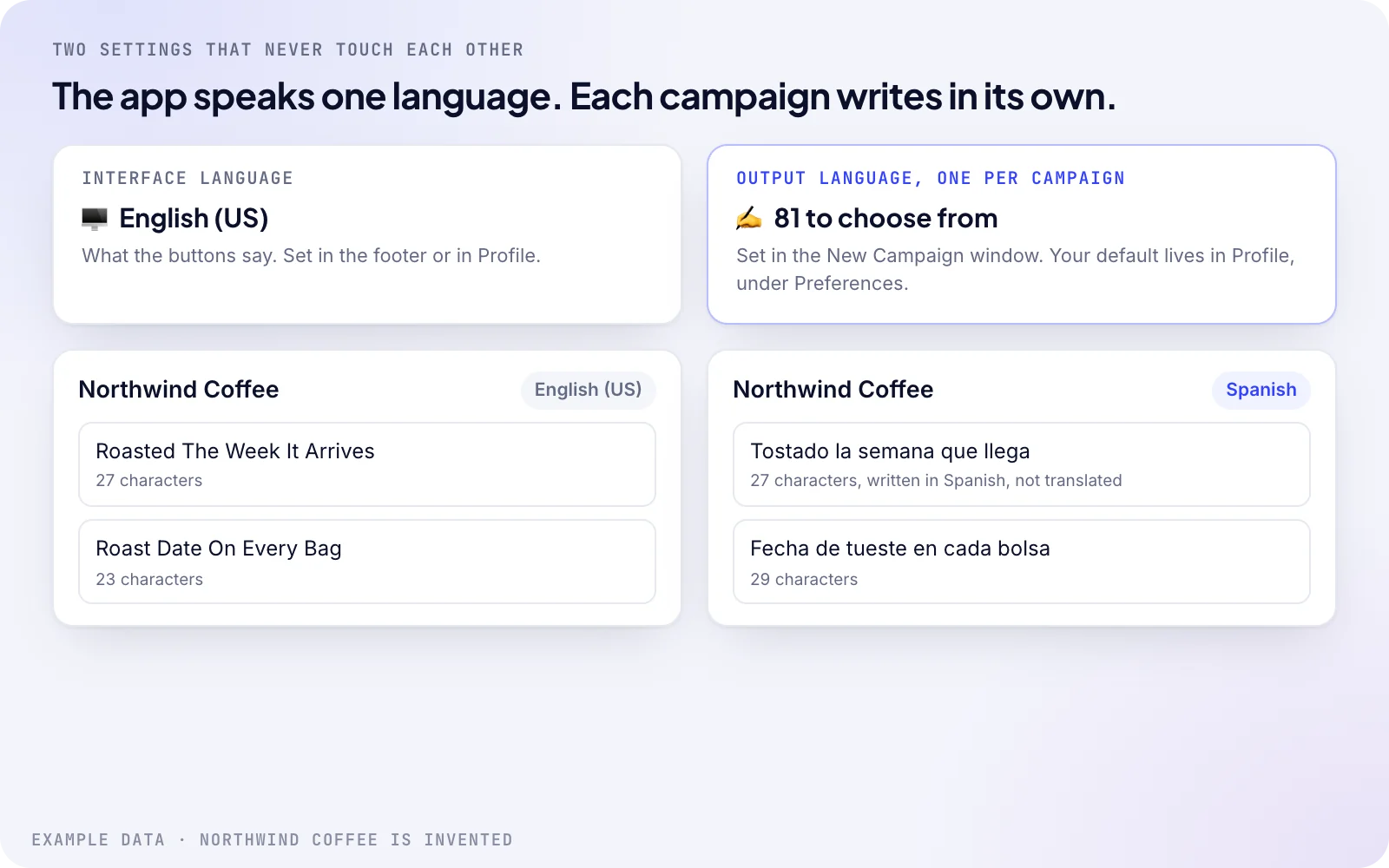
Interface language is what the app itself is in, chosen in the switcher.
Output language is what your generated marketing is written in, chosen once per campaign, across eighty-one options.
They are independent. You can run the app in English and generate Portuguese ads, which is exactly what most agencies need.
Setting it
Output language sits alongside the creativity level in the New Campaign window, and everything in that campaign is written in it. Your default for new campaigns lives in your Profile, under Preferences.
For a second language, create a second campaign from the same address. It reads your site again and writes its own brief in that language, which is what you want anyway: the brief behind Spanish ads should be written in Spanish.
What this is and is not
The output is written in the target language rather than translated into it. That distinction matters: a translated English headline is usually a stiff foreign headline, because idiom does not survive the trip.
What it cannot do is know the local market. Search behaviour, the words buyers use, seasonal timing and the competitive set all differ by country, and none of that comes from a language setting.
If the market matters, run research for that market. A brief and research grounded in the local landscape produce local copy; a language toggle produces correct grammar.
Practical notes
Character limits. Ad platform limits are counted in characters, and languages compress differently. German runs long, and where Google halves its limits for double-width scripts, the counts shown in Aiter are still the Latin numbers, so check the length of anything generated in Chinese, Japanese or Korean before uploading.
Formality. Languages with a formal and informal register need a consistent choice. Pick one and hold it across a campaign, because mixing them is the tell that reads as machine translation.
Names and claims. Product names, legal claims and guarantees should be checked by someone who reads the language, whatever tool produced them.
Frequently asked questions
Does changing the interface language change my output?
No. They are separate settings and neither affects the other.
Can one campaign hold several output languages?
No. A campaign writes in the language it was created with. One campaign per language keeps each brief, and everything built on it, consistent.
Is the quality even across all eighty-one?
Widely spoken languages have more material behind them and come out stronger. For a smaller language, a native read before publishing is worth the ten minutes.